Ocean freight spot rates have largely levelled off following earlier volatility. Carrier capacity management, including blank sailings and network adjustments, is helping to prevent further rate erosion. However, pricing remains sensitive to shifts in demand, with limited growth momentum in most major trades.
Capacity availability is broadly sufficient on paper, but effective capacity is still impacted by schedule reliability issues and ongoing operational disruption. This continues to reduce usable supply in certain regions, particularly where congestion or rerouting persists.
Equipment positioning remains uneven. Container availability is generally adequate in major export hubs, but imbalances persist in select secondary ports, with repositioning delays and regional surpluses still affecting efficiency.
Overall, the market is moving into a more balanced phase, but it remains fragile. Rates are stabilising rather than strengthening, and both capacity and equipment dynamics continue to be shaped by operational constraints rather than pure demand growth.
Carriers Tighten Capacity to Stabilise Rates
Blank sailings and network control supporting rate stability
Spot rates holding after recent softening
Demand remains uneven across trade lanes
Ocean carriers are actively managing capacity to prevent further declines in spot rates across key trades.
Following a period of sustained softening, spot rates on Asia–Europe routes have largely returned to pre-crisis levels. With demand remaining uncertain, carriers are taking steps to avoid a sharp “free-fall” in pricing.
Capacity control measures—including blank sailings and network adjustments—are being used to better align supply with demand. This strategy has helped stabilise rates in the short term and avoid aggressive price competition.
While rates are no longer falling rapidly, the market remains fragile. Carrier-led discipline is now a key factor shaping pricing, with further adjustments likely depending on how demand develops in the coming weeks.
Ocean carriers are actively managing capacity to prevent further declines in spot rates across key trades.
Following a period of sustained softening, spot rates on Asia–Europe routes have largely returned to pre-crisis levels. With demand remaining uncertain, carriers are taking steps to avoid a sharp “free-fall” in pricing.
Capacity control measures—including blank sailings and network adjustments—are being used to better align supply with demand. This strategy has helped stabilise rates in the short term and avoid aggressive price competition.
While rates are no longer falling rapidly, the market remains fragile. Carrier-led discipline is now a key factor shaping pricing, with further adjustments likely depending on how demand develops in the coming weeks.
Persistent Delays Remove Up to 6% of Global Capacity
Schedule reliability continues to reduce effective capacity
Delays and disruption still impacting vessel utilisation
Market operating below nominal fleet availability
Global container shipping continues to operate under structurally weaker schedule reliability, with delays effectively removing up to 6% of fleet capacity from active use, according to Sea-Intelligence.
The analysis highlights that persistent disruption and congestion mean a meaningful share of vessels are not operating as planned, reducing effective global capacity even when nominal fleet size remains unchanged. This “hidden capacity loss” has become a recurring feature of the market rather than a temporary event.
Historically, vessel delays typically absorbed around 1–3% of capacity, rising to 3–5% during periods of disruption. Current levels remain elevated, contributing to ongoing tightness in parts of the network.
While conditions have improved from peak disruption periods, schedule instability continues to impact vessel availability, planning reliability, and overall network efficiency across major trade lanes.
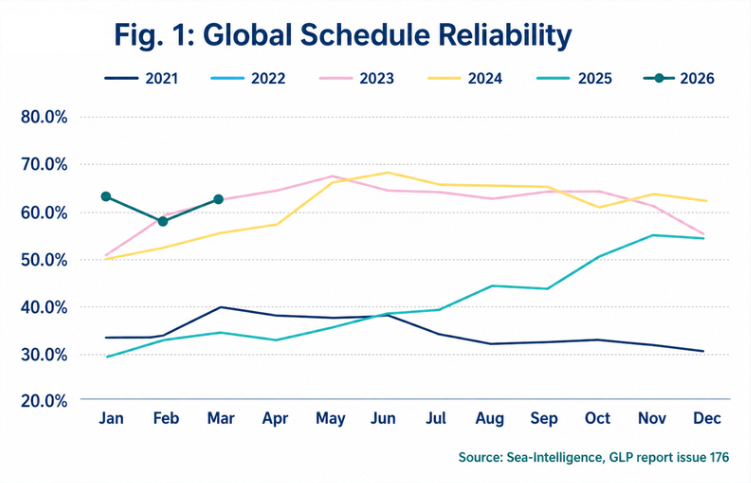
Schedule Reliability Improves, but Delays Persist
Global schedule reliability reached 62.2% in March, the joint-highest level this year
Performance improved both month-on-month and year-on-year
Average delays remain elevated at over five days
Global schedule reliability showed further signs of improvement in March, reaching its joint-highest level of the year. The increase reflects a gradual recovery in carrier schedule performance following prolonged periods of disruption.
Month-on-month and year-on-year gains indicate that networks are becoming more stable, supported by carrier efforts to manage capacity and improve operational consistency.
However, despite these improvements, overall reliability remains well below historical norms. Average delays continue to exceed five days, underlining the ongoing impact of congestion, port inefficiencies, and network disruption.
Middle East Landbridge Capacity Under Pressure
Demand far exceeds available trucking capacity
Overland routes seeing sharp rate increases
Limited scalability due to equipment and infrastructure constraints
With disruption to ocean routes through the Strait of Hormuz, cargo is increasingly being diverted via overland corridors linking key ports such as Jeddah, Khor Fakkan and Salalah. This shift has driven demand for trucking well beyond available supply—currently estimated at four to five times capacity.
As a result, inland transport rates have surged sharply. Trucking costs on key routes, such as Jeddah to the UAE, have risen by up to 4–5x compared to pre-conflict levels, making these solutions costly and difficult to scale.
While landbridges provide a partial workaround to ongoing disruption, limited capacity and elevated pricing mean they are not a sustainable long-term alternative for most supply chains.
Carriers continue to manage flows where possible, but constraints remain across the region.
Air Cargo Rates Ease as Capacity Returns
Air cargo rates are starting to stabilise as additional capacity returns to the market and supply begins to outpace demand on some routes. This follows a period of strong rate increases driven by earlier disruption and capacity constraints, with spot prices now flattening across major trade lanes.
Capacity recovery is being supported by improved aircraft availability and the gradual normalisation of passenger bellyhold space, particularly on long-haul services. However, recovery is uneven, with some lanes still operating below typical seasonal capacity levels.
At the same time, demand growth remains modest and continues to lag behind supply in certain markets, contributing to softer pricing pressure in those areas. However, the market remains tight overall. Elevated fuel costs and ongoing operational constraints continue to limit full capacity recovery and support pricing levels, particularly on longer-haul and high-demand routes.
Overall, conditions are improving but remain sensitive to cost pressures, capacity shifts, and relatively fragile demand trends.


.png)
.png)
.png)
.png)

.png)

.png)

